
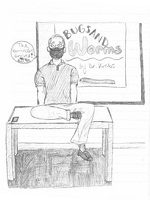
| Title: | Professor |
| Dept: | Biological, Geological and Environmental Sciences |
| Office: | SR G74 |
| Phone: | 216-523-7553 |
| Email: | R.KREBS@csuohio.edu |
| Address: | 2121 Euclid Ave. SR G74, Cleveland, OH 44115 |
|
| Education: | ||
|
B.S., Biochemistry, Virginia Tech, 1984
M.S., Biology, Virginia Tech, 1986 Ph.D., Zoology, Arizona State University, 1989 | ||
| Brief Bio: | ||
| My dual interests in biology and chemistry first took me to Virginia Tech, as the only university in Virginia then that offered a degree titled Biochemistry. In time, I pursued questions in WHY organisms behave the way they do, wording that indicated an interest in evolution and speciation. Thus I left chemistry and took a Masters studying morphological evolution and constraints. From there, I followed the famous line of Horace Greeley,'Go West, young man' to research behavioral mechanisms in speciation for a Ph.D. in Arizona, and several research positions: in population divergence and environmental variation in Australia, developmental variation in high temperature tolerance at the University of Aarhus, DK (with field work in the Canary Islands), and eventually the underlying molecular basis of such changes at the University of Chicago.
Tempering my westward migration, I came east to Cleveland, where since 1997 I have continued to study the relationship between environmental variation and genetic divergence within species, moving from a model species group, fruit flies, to freshwater mussels. These animals have largely failed to adapt to the changes of urban living, often declining in numbers or disappearing completely. Understanding their tolerance limits to diverse stresses in rivers and lakes is a critical step to initiate recovery, and also one necessary to understand the population biology of this enigmatic family of mollusks. | ||
| Honors and Awards: | ||
| Repeat winner McNair Mentor-of-the-year (May, 2012, 2015) | ||
| Creative and Activities: | ||
| I maintain a large display in the hallway of the Science Research Bldg. presenting numerous examples of the past and present economic use of mollusks, an adjoining display on historical aspects of the study of Evolutionary Biology, Darwinism and Natural History, and a great example of an evolutionary outcome, the enigmatic sea shells people collect that evolved in response to increasing predator efficiency across time.
I participated in a podcast with a Comedian, Shane Mauss, on how people perceive animals in nature and their evolution - it's an hour long and possibly even worth the time. http://www.herewearepodcast.com/episode/12/bob-krebs | ||
| Research Interests: | ||
| My research interests have moved from a long history of work on the underlying physiological and ecological causes of population divergence primarily in Drosophila as a model organism, to an examination of the response of freshwater mussels in the family Unionidae to the many stresses imposed by urbanization and agriculture. Loss of unionid mussels became a state and national wildlife concern. Within the Lake Erie watershed, populations in the numerous small rivers flowing to the lake are largely isolated, as the introduction of zebra and quagga mussels (family Dreissinidae) decimated native mussel populations. Currently, water quality is improving, providing an unusual opportunity to track migration and gene flow as species recolonize habitat within watersheds. However, defining the conditions necessary for mussels to recover has remained challenging, while characterizing degradation is often simple.
Determining what animals need to live well is the next step, with a special interest in reintroductions and augmentation of depleted populations of mussels in the regions rivers.. | ||
| Teaching Areas: | ||
| Animal diversity, Behavior, Biogeography, Evolution, Population Biology, Writing in Biology, and Human Biology (for non-majors). | ||
| Professional Affiliations: | ||
| American Malacological Society
Cleveland Zoological Society | ||
| University Service: | ||
| I am the past President of The Faculty Senate, elected April, 2020 through Summer, 2022. I sat 15 years on the CSU-AAUP Executive committee first as Secretary, then Treasurer, Vice President and finally President from 2014 to 2018, and best of all, past president, ending in 2020.
I have served on many and diverse committees, now focusing on student success in my department. | ||
| Professional Service: | ||
| Occasional Reviewer for numerous journals.
Review of Texts/Edited Books: Miller and Harley, Zoology 5th ed., selected chapters, MacGraw Hill, Freeman and Herron, Evolutionary Analysis, 1st ed., Prentice Hall, Halliburton, Population Genetics 1st ed., selected chapters, Prentice Hall. Goodenough, Human Biology, 1st ed. selected chapters, Prentice Hall; Environmental Factors, Cellular Stress and Evolution, S. C. Lakhotia, editor. Reviews for Grant Agencies: served on an NSF Panel for DDIG awards (March, 2003), NSF grant reviews (several annually), NWO Veni programme (Innovational Research Incentive Scheme, The Netherlands). Outside Ph.D. dissertation evaluations: Aarhus Univeristy, DK, Melbourne University, AU, Monash University, AU, Stellenbosch University, South Africa. | ||
| Community Service: | ||
| I work with the Cleveland Museum Natural History, Natural Areas division and with many of the areas park systems: The Cuyahoga Valley National Park, Cuyahoga County Metroparks, Geauga County Metroparks, Lake County Metroparks and Summit County Metro Parks. | ||
| Research Grants: | ||
| Recent:
2023-2025 - National Park subcontract - Habitat assessment and reintroduction of mussels to the lower Cuyahoga River ($141,000 over 3 years) 2021 - Geauga County Parks - Modeling connectivity among land use, habitat and two interconnected fauna, mussels and fishes, in the Geauga County highlands ($3,000). 2011-2014- Great Lakes Fish and Wildlife Restoration Act FY 2010: Conservation of native freshwater mussel refuges in Great Lakes coastal zones, Funded in full. This multi-investigator collaborative grant asks for $381,000 ($21,000 in as a pass through to my laboratory). . | ||